






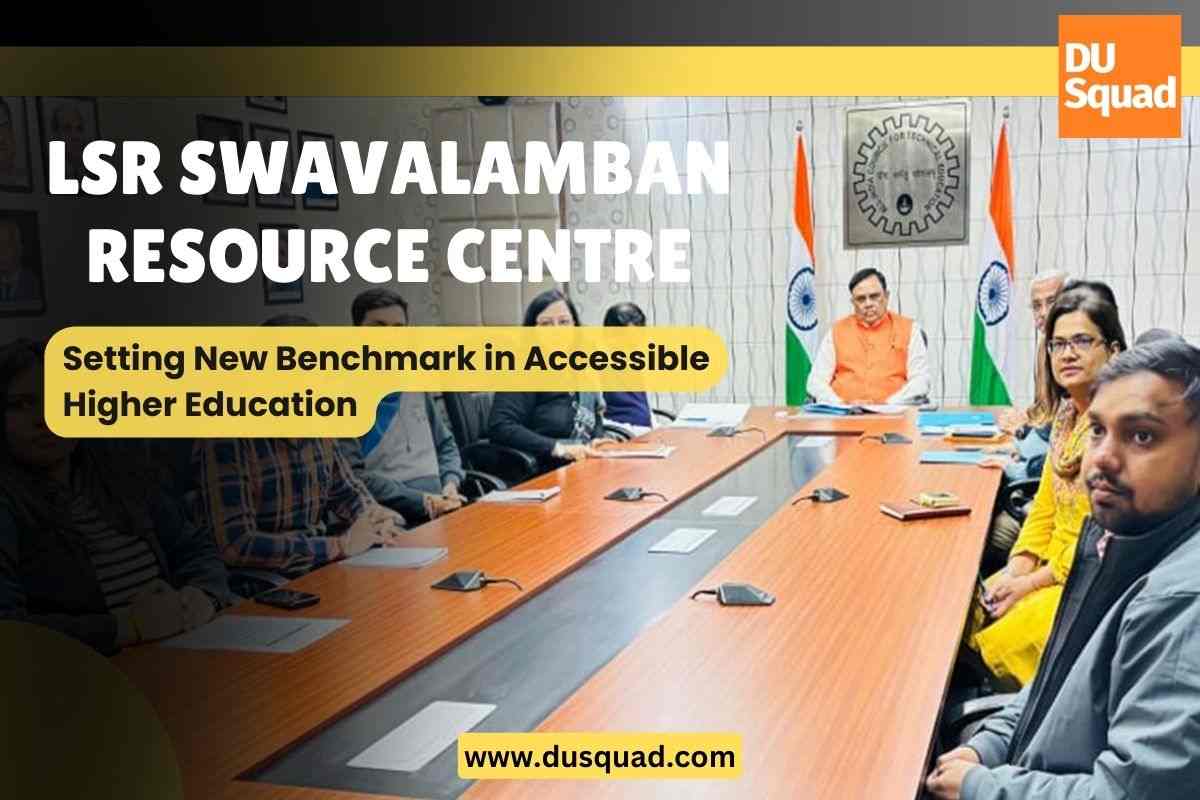

The recent inauguration of the upgraded LSR Swavalamban Resource Centre marks a significant institutional shift towards technologically enabled inclusion in Indian higher education. By integrating advanced assistive technologies with a long-standing support framework for students with disabilities, Lady Shri Ram College for Women has reinforced its reputation as a leader in equitable academic infrastructure under the University of Delhi system.
The restructured centre is not merely a physical upgrade of equipment, it represents a deeper transformation in how access, independence, and dignity are being redefined for students with diverse learning needs. With growing enrolment of students with disabilities across Delhi University, the role of institutional resource centres such as Swavalamban has become both pedagogically and ethically central.
The Vision Behind the LSR Swavalamban Resource Centre

The LSR Swavalamban Resource Centre was originally established to facilitate academic participation for students with visual and other disabilities through structured support services. Over the years, it has evolved from a small support unit into a multi-technology learning hub.
The core philosophy of Swavalamban is anchored in three principles:
• Academic independence rather than dependency
• Dignified access to learning resources
• Equal participation in classroom and campus life
The latest upgrade aligns this philosophy with contemporary developments in artificial intelligence, digital accessibility and assistive design.
Why the Upgrade (LSR Swavalamban Resource Centre) Was Necessary
Despite progressive disability policies in Indian higher education, access gaps remain acute at the level of daily academic participation. Students with disabilities often face structural barriers such as:
• Inaccessible printed reading material
• Delay in the conversion of textbooks into accessible formats
• Limited availability of real-time classroom support
• Dependence on human readers and scribes
• Technological exclusion during digital learning
At LSR, the number of students formally registered under disability categories has steadily increased. This demographic transition made the upgradation of the LSR Swavalamban Resource Centre not just desirable but institutionally unavoidable. The new centre directly responds to the changing academic ecology of contemporary university education.
Key Highlights of the Upgraded LSR Swavalamban Resource Centre
The upgraded centre now operates as a comprehensive assistive technology ecosystem rather than a single-function support unit. Major additions include:
1. AI-Enabled Reading and Recognition Tools
• Devices that scan printed and handwritten text instantly
• Real-time audio conversion of physical documents
• Image description and barcode identification
• Multilingual text processing
2. Refreshable Braille and Tactile Displays
• Digital text rendered in real-time Braille
• Compatibility with laptops and mobile devices
• Enables direct access to PDF, Word and web documents
• Supports exam preparation without intermediaries
3. Advanced Digital Scanning and OCR Systems
• High-resolution document scanning
• Text to speech functionality
• Support for structured academic reading
• Allows creation of personalised digital libraries
4. Portable Video and Optical Magnification Devices
• Hand-held magnifiers for low-vision users
• Adjustable zoom, contrast and brightness
• Useful for classroom handouts, library books and noticeboards
5. Assistive Software Infrastructure
• Screen-reading software
• Digital talking book platforms
• Learning support and dyslexia-friendly reading tools
• Voice-based note-taking systems
6. Accessible Computer Workstations
• Ergonomically designed seating
• Large-print and tactile keyboards
• Audio output systems
• Disability-friendly user interfaces
Together, these upgrades convert LSR Swavalamban Resource Centre into a full-spectrum accessibility laboratory for higher education.
Institutional Leadership and Governance
The reopening and expansion of the LSR Swavalamban Resource Centre was carried out in the presence of senior academic and regulatory representatives, including the chairperson of National Council for Teacher Education. The involvement of national-level education authorities highlights the growing policy recognition of inclusive infrastructure in university ecosystems.
The project has been guided by faculty members trained in assistive pedagogy and universal design for learning, in coordination with the college administration. The initiative also benefited from alumni-supported philanthropic funding, signalling a growing culture of social reinvestment in public higher education institutions.
Academic and Social Impact on Students
The functional value of the LSR Swavalamban Resource Centre extends well beyond mere technological novelty and is reflected clearly in the everyday academic and social experiences of students. For students with visual impairment, the centre ensures immediate access to study material through digital and audio formats, enabling autonomous reading without dependence on scribes or human assistance. This independence facilitates equal participation in classroom discussions, internal assessments and university examinations while also significantly reducing the psychological stress that often accompanies accessibility barriers.
For students with low vision and learning disabilities, the centre provides customised magnification, adjustable contrast settings and audio-visual learning reinforcement that directly address varied learning needs. Dyslexia-supportive reading formats and voice-enabled study tools further enhance comprehension and retention, allowing students to engage with academic content in a manner suited to their individual learning patterns. These provisions contribute to improved academic performance and sustained confidence in classroom participation.
The wider student community also benefits from the presence of the LSR Swavalamban Resource Centre. Regular interaction with inclusive learning environments fosters a disability-sensitive peer culture and promotes empathy, cooperation and social responsibility among students. The increased interaction between disabled and non-disabled students strengthens campus integration and reinforces the idea of shared academic spaces rather than segregated support systems.
For faculty members, the centre simplifies the preparation of accessible teaching materials and provides institutional guidance on inclusive pedagogical practices. The availability of structured support mechanisms reduces the dependence on ad-hoc accommodation processes, allowing teachers to focus more effectively on instruction while ensuring equity in evaluation and classroom engagement.
Conclusion
The upgraded LSR Swavalamban Resource Centre represents a decisive move from symbolic inclusion to technologically guaranteed academic access. By embedding assistive intelligence, tactile computing and accessible pedagogy within a single institutional framework, Lady Shri Ram College has redefined what disability -responsive higher education can achieve in India.
More than a facility, Swavalamban now stands as a statement of educational justice– one where academic ability is no longer constrained by the limits of physical access but liberated through intelligent design and institutional will.
FAQs
Que 1. What is the LSR Swavalamban Resource Centre?
Ans. The LSR Swavalamban Resource Centre is a dedicated accessibility and assistive technology unit at Lady Shri Ram College for Women that supports students with disabilities through specialised learning tools and academic services.
Que 2. Who can use the Swavalamban Resource Centre?
Ans. The centre primarily serves students with registered disabilities at LSR. Faculty members may also use it for preparing accessible teaching materials and inclusive academic planning.
Que 3. What technologies are available at the upgraded centre?
Ans. The centre houses AI-based reading devices, refreshable Braille displays, OCR scanners, screen-reading software, audio learning systems, portable magnifiers and accessible computer workstations.
Que 4. How does the centre support independent learning?
Ans. By converting physical text into audio and tactile formats in real time, the centre enables students to read, prepare notes, revise and complete assignments without depending on human assistants.
Que 5. Why is this upgrade academically significant?
Ans. It integrates artificial intelligence with disability support, thereby reducing structural barriers in learning and promoting equal academic participation.