






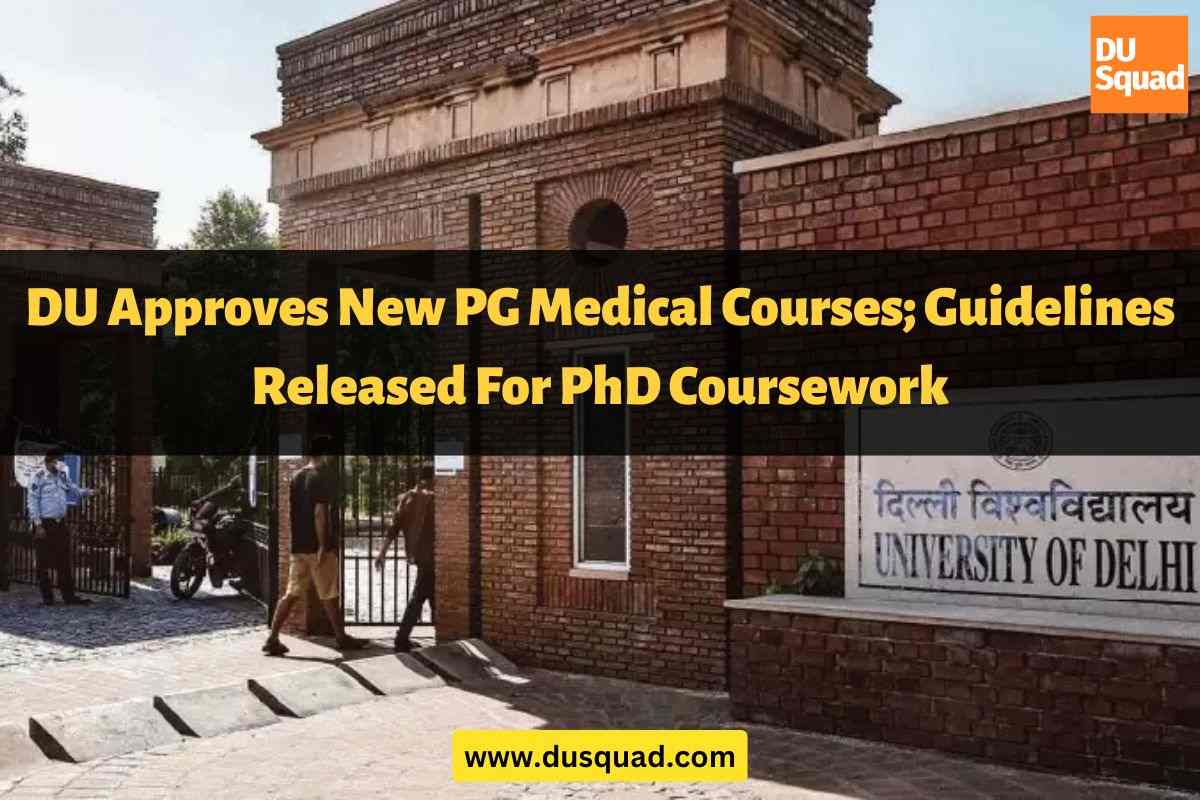

The Delhi University (DU) recently approved fresh plans for DU PG medical courses and simultaneously introduced new guidelines for doctoral-level training through updated PhD coursework rules. This significant decision marks an important shift in how DU intends to strengthen both its clinical and research-ready offerings.
What’s New: DU PG Medical Courses and PhD Coursework Guidelines
During its most recent Academic Council meeting, DU cleared the proposal to start nine postgraduate medical courses at the Indian Railways Post-Graduate Institute of Medical Sciences and Research (IRPGIMSR) under the Northern Railway Central Hospital ― subject to approval from the National Medical Commission (NMC). The approved specialisations include core medical disciplines such as anaesthesia, general medicine, surgery, orthopaedics, ophthalmology and paediatrics.
Along with these clinical expansions, DU approved a revised, standardised framework for doctoral studies. Under the new DU PhD coursework guidelines, all departments will adopt a uniform credit-based coursework program (12–16 credits), which will include mandatory modules on research methodology, research tools and publication ethics. The policy aims to formalise pre-thesis training and ensure research scholars are equipped for rigorous academic work.
Why the Update of DU PG Medical Courses Matters
The approval of new PG medical programs DU signals DU’s readiness to address growing demand for specialist medical education, even as national regulations evolve. Given the rigorous application and approval process mandated by NMC for any new postgraduate medical qualification — including documentation, institutional assessment, and compliance with regulatory norms — DU’s move reflects careful planning and compliance readiness.
On the research front, the DU PhD coursework guidelines promise to standardise doctoral training across departments. By mandating training in research methods and ethics before thesis work begins, DU may raise the baseline quality of dissertations, encourage better supervision, and help produce more credible and impactful research outcomes.
Core Features of the New Structure of DU PG Medical Courses

Here’s a snapshot of what the new medical and PhD coursework policies bring:
- PG Medical Courses: Nine new PG seats across specialities such as general medicine, surgery, anaesthesia, orthopaedics, ophthalmology and paediatrics at IRPGIMSR — pending NMC approval.
- PhD Coursework: Uniform 12–16 credit coursework requirement across all departments. Includes core modules like research methodology, ethics, research tools, and possibly training on publication norms and digital research aids.
- Improved Governance: The dual decision also reflects DU’s broader attempt to shift from a reliance on temporary or guest faculty toward strengthening permanent faculty positions and institutional accountability.
Potential Benefits for DU Students and Research Community
For MBBS graduates and those eyeing specialization, increased PG seats under Delhi University medical courses offer new opportunities — and reduce competition pressure on other medical colleges. It allows more candidates to pursue MD/MS training under DU’s umbrella, possibly improving access to quality medical education.
For aspiring researchers, the new PhD coursework policy helps create a structured path toward research. Early exposure to methodology, ethics, and research tools can build stronger foundations, encourage inter-disciplinary collaboration, and produce better-designed doctoral studies.
At the institutional level, these steps could enhance DU’s medical education infrastructure and research output, thereby strengthening its academic reputation.
Concerns, Challenges and What Could Affect Implementation
Despite the positive outlook, several potential challenges remain before the changes become fully effective:
- Approval from the NMC is mandatory for new PG medical courses — until then, seat availability remains uncertain.
- DU must ensure adequate hospital infrastructure, faculty strength, and clinical exposure at the IRPGIMSR to deliver quality PG medical education. Without these, new courses may remain only on paper.
- For PhD coursework, departments need trained supervisors, proper scheduling, and workload planning. The uniform coursework requirement may strain faculty resources if not accompanied by additional hiring or support.
- Transition may take time; candidates and departments must wait for official notifications, syllabus release, and admission guidelines before they can benefit.
Some AC (Academic Council) members have reportedly raised dissent notes regarding various institutional issues alongside these approvals — underlining the importance of transparent, inclusive implementation.
What Students & Scholars Should Watch For
- Official announcements from DU’s medical faculty or IRPGIMSR on seat allocation, admission criteria, and course start dates.
- NMC clearance for the proposed PG medical courses — a critical step before admissions begin.
- Departmental notices about PhD coursework syllabi, credit mapping, and registration processes for doctoral candidates.
- Updates on staffing and infrastructure, especially for clinical departments, to ensure promised medical courses are adequately supported.
Conclusion
Approval of DU PG medical courses and adoption of DU PhD coursework guidelines reflect a strategic push by Delhi University to expand its medical education offerings and strengthen research training. If implemented well — with adequate infrastructure, faculty support, and regulatory compliance — these moves could open up more opportunities for medical graduates and research scholars alike under DU’s banner. However, timely regulatory approvals, resource planning, and transparent rollout will be key to turning this policy decision into tangible outcomes.